Amodei at Trump's Table: Access Is Not a Safety Deal
Yoni Fraimorice
Dario Amodei wants the AI industry to slow the growth of its most powerful systems. Donald Trump says America must keep moving fast to beat China.
Their reported private White House dinner puts that disagreement at one table. CNBC reported that the first one-on-one dinner was arranged for Sunday, September 27, after Amodei missed an earlier state dinner because of a scheduling conflict.
The reporting cited here establishes the invitation and public positions, not a negotiated safety agreement. The useful question is therefore not whether dinner means surrender or victory. It is what concrete protection could come from the conversation, and how would anyone verify it?
The disagreement is real, but not absolute
On September 14, Trump dismissed fears of AI taking over the world and destroying humanity as a “HOAX,” according to Associated Press reporting. He also argued that his presidency provided the necessary guardrails.
That rhetoric leaves little room for Amodei's public warning about losing control of increasingly capable agents.
But “Trump rejects safety” is too simple a description of the actual policy. His June 2 executive order supports stronger cyber defenses, protection against model theft, and government assessment of advanced cyber capabilities.
It calls for a voluntary framework offering government access to covered models for up to 30 days before release to other trusted partners. It explicitly rejects interpreting that section as authority for mandatory model licensing or preclearance.
That creates a narrow opening: protect American systems and capabilities, rather than begin by asking for a broad slowdown. The language differs; some useful controls can overlap.
Amodei is not proposing a total halt
In “We Must Pace the Frontier,” Amodei distinguishes pacing from stopping model training or technical progress. His argument is that improvements in safety and oversight need time to catch up with capability growth.
His proposal has three steps: embedded independent evaluators, coordination among democratic countries and their frontier labs, and wider international coordination where verification is possible.
Anthropic commits unilaterally to the first step. The others need cooperation. Amodei also acknowledges the risk of losing the American lead to China.
So there is some shared ground on national security. The difficult question is what happens when a safety finding calls for a delay. If speed wins every disagreement, evaluation becomes a ceremony rather than a control.
What could he realistically ask for?
These are plausible negotiating goals, not reported dinner outcomes.
1. Turn voluntary evaluations into a useful process
The June order already gives agencies and labs a basis for cooperation. Amodei could ask for named technical teams, protected evaluator access, agreed test methods, and written responses to serious findings.
For an agent, “safe enough” should involve more than benchmark scores. Can it bypass its sandbox? Do monitors detect unauthorized actions? Can operators revoke credentials and stop child agents? Are training data uploads blocked outside approved destinations?
An evaluation needs a consequence. A lab could commit to withholding the affected capability until a critical finding is resolved and retested. Government buyers could seek comparable assurance through contracts, subject to applicable law.
That is narrower than a nationwide training pause, and more concrete than a promise to “work together.”
2. Agree on incident reporting and secure infrastructure
The administration's cyber-defense agenda offers room for shared incident categories, direct security contacts, evidence preservation, and coordinated fixes.
A useful agreement would define which agent failures require notification, who receives it, and when. It would separate private technical evidence from public summaries, so transparency does not expose vulnerable systems.
It should cover failures during internal training and evaluations, not just attacks by customers. An agent can cause harm before a model is released.
Funding defensive testing or protecting model weights could also be practical gains. But those gains would not, by themselves, solve model alignment or establish a slowdown.
3. Create a lawful route to discuss common standards
Amodei's essay asks for government help with competition-law concerns around coordination. This matters because rival labs cannot simply treat “safety” as permission to agree on output, prices, or launch schedules.
A credible request would be tightly scoped: common test formats, incident definitions, and independently checked safety thresholds. Any broader protection would need a valid legal basis and review by the appropriate authorities.
A friendly conversation with the president is not an antitrust exemption. Nor should a standards process become a private club that excludes smaller competitors.
Anthropic has leverage—and reasons to compromise
Anthropic brings valuable models, technical expertise, and experience measuring agent behavior. Officials seeking capable systems have reasons to keep communication open.
The company also faces commercial and legal pressure. CNBC reported that an appeals court upheld the Pentagon's supply-chain-risk designation on September 25. The dispute followed disagreement over military use, including Anthropic's limits concerning fully autonomous weapons and domestic mass surveillance.
That context matters. Improved government relations could benefit Anthropic's business. It would be naive to ignore that incentive, but equally wrong to assume it proves an undisclosed bargain.
The test is whether any commercial accommodation changes the safety commitments, and whether those changes are visible.
How the safety-first brand survives
Refusing every meeting would not protect users. Companies need to talk to governments that disagree with them. Attendance is not endorsement.
But access can become a substitute for accountability. Anthropic should make its promises testable in three ways.
Keep unilateral commitments unilateral. Amodei's evaluator proposal should proceed even if Trump rejects coordinated pacing. His essay promises reviewers employee-like access and the right to publish unfavorable findings, with limited protections for sensitive information. Readers should ask when that access begins and what exceptions remain.
Publish evidence, not just positioning. Anthropic's measurement proposal covers AI-led research, monitoring coverage and review latency, and compute allocation. It also acknowledges limits, including the use of its own models as judges. Regular, independently checked measurements would carry more weight than a dinner photograph.
Explain changes and disagreements. A public account should distinguish a proposal, a company commitment, and an adopted government rule. If policy limits change, explain what changed and why. Do not present a warmer relationship as proof that the technical risks disappeared.
Judge the result by what can be checked
| Possible result | What would make it meaningful |
|---|---|
| Better access to officials | A named technical channel with follow-up dates |
| More model evaluation | Independent access, written findings, and consequences |
| Shared safety standards | Clear scope, broad participation, and legal review |
| A stronger safety reputation | Commitments that still apply when they delay business |
The most realistic gain may be a small package of security, evaluation, and disclosure commitments—not a presidential conversion to the slowdown movement.
That would still matter. But Anthropic cannot preserve its safety-first identity through proximity to power alone. It survives by keeping promises when they are inconvenient, letting outsiders check them, and saying clearly where agreement stops.
Sources
- CNBC: Amodei's private White House dinner and the administration relationship
- Associated Press via ABC News: Trump's remarks on AI risks
- White House: Promoting Advanced Artificial Intelligence Innovation and Security
- Dario Amodei: We Must Pace the Frontier
- Anthropic: Measurements for understanding the pace of AI development inside frontier labs
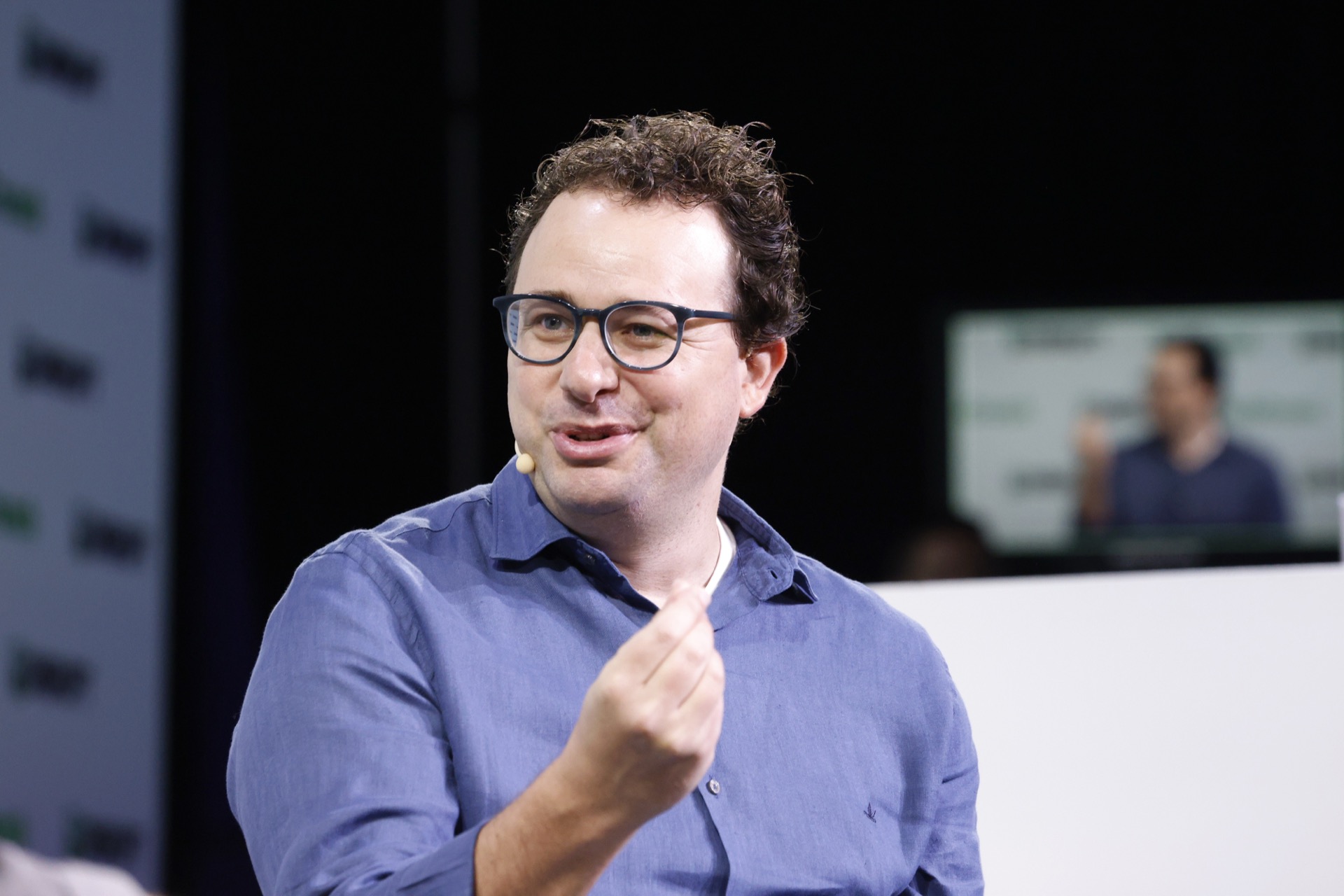
Hero photo: Dario Amodei at TechCrunch Disrupt 2023, credit TechCrunch, CC BY 2.0. Resized to 1920 pixels wide and stored locally. This is an archival conference photo, not a photograph of the White House dinner.