
The 17-Day AI Access Freeze: What the UK Actually Lost
Yoni Fraimorice
For 17 days, the UK reportedly lost early access to some of the most advanced AI models built by American companies. Then the United States reversed course.
The Telegraph reported that the White House had asked US labs to pause pre-release access for the UK's AI Security Institute, or AISI, while the US completed its own national-security review. LBC reported that the restriction was lifted after lobbying by UK AI minister Kanishka Narayan.
The reported pause began on September 24 and ended on October 11.
Neither government has published the directive, the list of affected models, or the technical terms of restored access. The public evidence supports a policy reversal, but not claims about the exact API tier, safeguards, quotas, or model checkpoints involved.
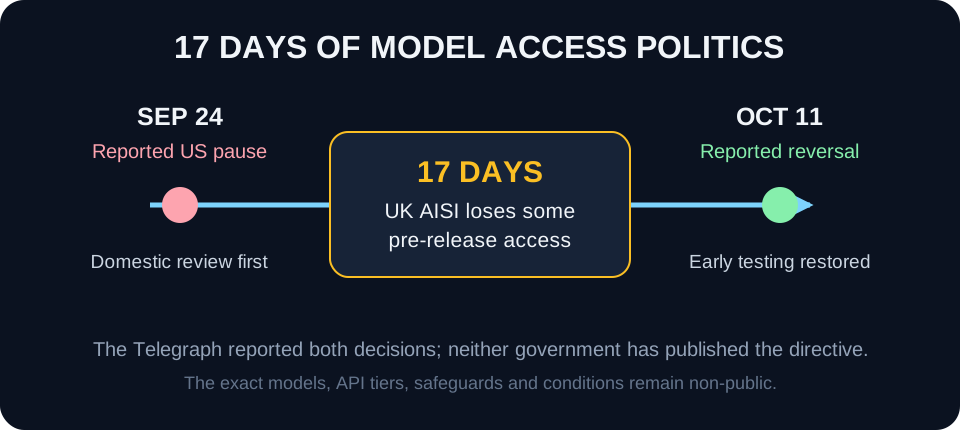
The timeline is based on press reporting. The governments have not published the underlying instruction.
What "access for safety testing" means
The phrase sounds like Britain receives a copy of a model. Usually, it does not.
For closed frontier systems, testing normally combines a controlled model endpoint with an evaluation harness.
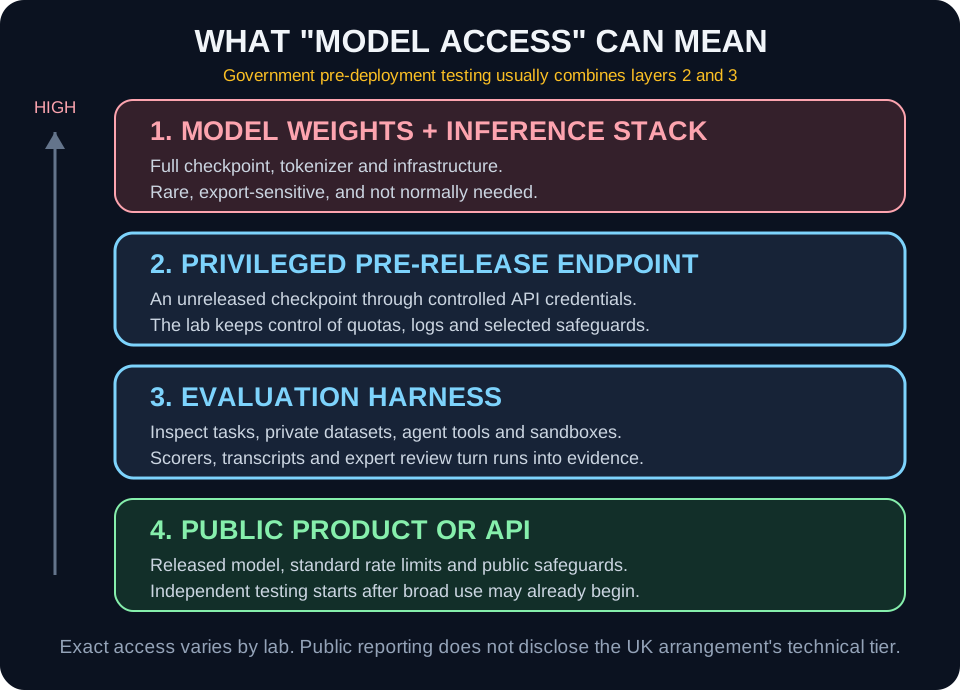
1. A privileged pre-release endpoint
The lab gives approved evaluators credentials for an unreleased or near-release model. The endpoint may have a specific checkpoint, higher quotas, detailed logging, or a safeguard configuration chosen for testing.
The evaluator can send many controlled requests without receiving the model's proprietary weights. The lab still operates the inference servers and can expire credentials, change limits, or end access.
The exact arrangement varies. Nothing public confirms which configuration the UK had during this episode.
2. An evaluation harness
The UK AISI develops Inspect, an open-source framework that connects model access to:
- Datasets containing questions or tasks
- Solvers that prompt a model or run it as an agent
- Tools such as browsers, shells, and external databases
- Sandboxes that isolate tool use
- Scorers that grade answers or completed actions
- Logs and transcripts for expert review
In a joint pre-deployment evaluation of OpenAI's o1, the UK and US institutes had access for a limited period before launch. They ran question-answering tests, agent tasks in virtual environments, and expert probing across cyber, biology, and software development.
That is real access. It is not ownership.
3. Model weights
Weights are the learned numerical parameters of the model. With weights and enough infrastructure, a holder can run the model independently, inspect it more deeply, fine-tune it, or remove deployment safeguards.
Transferring frontier weights is far more sensitive than granting API access. Public descriptions of UK pre-deployment testing do not show routine handover of proprietary US model weights.
Open-weight models are different because their checkpoints can be downloaded. But the reported dispute concerned early access to closed systems from US labs.
Why 17 days matter
Pre-deployment testing is valuable because it happens before the release decision is complete.
Evaluators can identify cyber capability, biological knowledge, autonomous behavior, or safeguard failures while a lab can still change the model, strengthen controls, narrow access, or delay deployment.
After public launch, an outside institute can still test the product. But three things are lost:
- Time: The model may already be available to millions of users.
- Configuration: Public safeguards and rate limits may hide the underlying capability an evaluator wanted to measure.
- Influence: Findings arrive after the deployment plan and public promises are set.
The o1 evaluation shows why the early window matters. The institutes adapted their agent scaffolding when tool calls failed, compared the model with reference systems, and shared findings with OpenAI before release.
Seventeen days can cover most of a short evaluation window.
Safety testing became an export-control bargaining chip
This was not necessarily a legal export-control action. No public rule or licence has been released. But the policy used export-control logic: sensitive American technology should be reviewed at home before a foreign government sees it.
Even black-box API access can reveal national-security information:
- Whether a model can discover or exploit software vulnerabilities
- Whether it meaningfully helps with biological research
- How well safeguards resist bypass attempts
- Which tasks show sudden capability jumps
- Which mitigations the lab has not yet deployed
The evaluation methods are sensitive too. Private benchmark tasks, jailbreak techniques, red-team prompts, and failure transcripts can teach both defenders and attackers where a model is weak.
That makes sequencing political. Who tests first can learn first, warn first, and influence the release conditions.
The UK's position is unusually strong. Google DeepMind's memorandum with the UK government promises AISI "priority technical access" to frontier models. Yet the memorandum is voluntary and not legally binding.
The reported freeze exposed the weakness in the whole system: access based on relationships can be removed by another political decision.
What this means for countries without a frontier lab
Most countries do not train frontier models and do not receive privileged access before release. They see the same public API as companies and researchers.
Publishing evaluation software does not solve that dependency. Inspect can define tasks, agents, tools, and scorers, but it still needs a model endpoint. A strong harness pointed at an older or heavily restricted model cannot measure a hidden pre-release checkpoint.
Countries without access face four choices:
| Option | What it provides | What it does not provide |
|---|---|---|
| Test public APIs | Independent evidence after release | Early warning or influence before launch |
| Evaluate open-weight models | Full local control and repeatability | Direct evidence about closed frontier systems |
| Join a regional testing body | Shared experts, compute, and bargaining power | Guaranteed access from foreign labs |
| Negotiate contractual access | A clearer pre-release process | Sovereignty if the supplier's government intervenes |
The realistic goal is not for every country to build a frontier lab. It is to build sovereign evaluation capacity:
- Skilled evaluation and red-team staff
- Secure compute and sandbox infrastructure
- Local-language and country-specific datasets
- Incident reporting and post-deployment audit powers
- Regional agreements that pool expertise and negotiating leverage
- Procurement rules that require evidence from independent tests
Countries should also ask for access terms that survive political changes: minimum testing windows, named model versions, stable quotas, documented safeguard settings, publication rights, and a process for suspending access.
The reversal did not remove the dependency
Restoring UK access is better than leaving the freeze in place. It does not turn a voluntary arrangement into a durable institution.
The lesson for the UK is that technical leadership without guaranteed access remains conditional. The lesson for everyone else is harder: if your safety programme depends on a foreign lab's API key, your oversight can disappear before the model arrives.
Sources
- LBC: White House reinstates UK access to new AI models for safety tests
- The Telegraph: Britain to get first look at new AI systems after White House U-turn
- UK AISI: Pre-deployment evaluation of OpenAI's o1 model
- UK AISI: Inspect evaluation framework
- UK government: AI Safety Institute approach to evaluations
- UK government: Memorandum with Google DeepMind
- Frontier AI Safety Commitments from the AI Seoul Summit
Hero photo: Bletchley Park Mansion, photographed by Wikimedia Commons user DeFacto on March 4, 2017. CC BY-SA 4.0. Resized from 4248 x 2502 to 1920 x 1131 pixels and JPEG-compressed; no other edits. This archival photograph shows Bletchley Park, the site of the 2023 AI Safety Summit. It does not show the reported 2026 access decision, an AI model, or a testing environment. No endorsement is implied.