
Java4Shell: Where Java's Memory Safety Stops—and Where AI Fits In
Yoni Fraimorice
Java's core security promise is managed memory: array accesses are bounds-checked, bad inputs raise exceptions, and ordinary decoding bugs do not overwrite neighboring objects on the heap.
On November 17, 2026, OpenJDK and Oracle patched Java4Shell (CVE-2026-114938), a heap out-of-bounds write inside OpenJDK's Base64 decoder, followed by an urgent CISA patching alert. Because Base64 carries login headers, tokens and uploads, malformed input can reach that decoder before authentication.
The disclosure by Calif makes bold headlines—from "Write once, RCE everywhere" to finding and exploiting a JVM bug in three hours for under $200 in AI tokens. Useful engineering lessons come from separating what is independently reproducible today from what rests on the researchers' claims.
Demonstrated results versus the researchers' claims
Part of Java4Shell can be verified directly in OpenJDK source and standalone tests; other parts rely on withheld exploit chains or self-reported workflow numbers.
| Topic | Independently verified or publicly established | Reported or claimed by Calif |
|---|---|---|
| Root cause and heap spill | Confirmed in OpenJDK 17.0.6+ (and Oracle 8u511b33-perf) on x86-64 CPUs with AVX-512 VBMI. Calif's public Base64Trigger test and Datadog Security Labs reproduce the 62-byte out-of-bounds heap write and JVM crashes. | Severity framing differs: Oracle and OpenJDK score it 8.1 (CVSS v3.1, reflecting high attack complexity); Calif scores it 9.2 (CVSS v4.0). |
| Product RCE scope | No public RCE exploit code and no confirmed in-the-wild attacks as of November 18. Both Calif and Datadog confirm there is no universal payload; every target needs custom heap alignment, and JVM crashes are far easier to trigger than RCE. | Pre-auth RCE reported (with demo video) on default Keycloak, Jira, Confluence, Artifactory, Jenkins and PingFederate; post-auth RCE on Kafka, Solr, Elasticsearch, Gerrit and Spinnaker; client TLS exploit credited to samczsun. Weaponized chains remain private pending patching. |
| AI discovery and exploit speed | OpenJDK's advisory credits Quang Luong, and HotSpot's C++ and assembly stubs are public code that coding models can inspect. | Self-reported workflow: ~1 hour with OpenAI Codex to find the bug, ~2 hours for a first exploit, under $200 in tokens, and "almost autonomous" later chains—after humans built custom heap-tracing tools and co-located cloud VMs. |
| "Vibe-uncoding" thesis | Turning off the intrinsic with -XX:-UseBASE64Intrinsics is a verified temporary mitigation. | Using AI to delete rarely needed optimizations across shared runtimes is an opinionated proposal with unmeasured throughput and regression trade-offs. |
Holding back weaponized payloads for identity and CI/CD servers is responsible disclosure. It also means outside teams have verified the memory-corruption primitive, not the exact reliability of each product chain across real networks.
What Java4Shell reveals about Java's native-code trust boundary
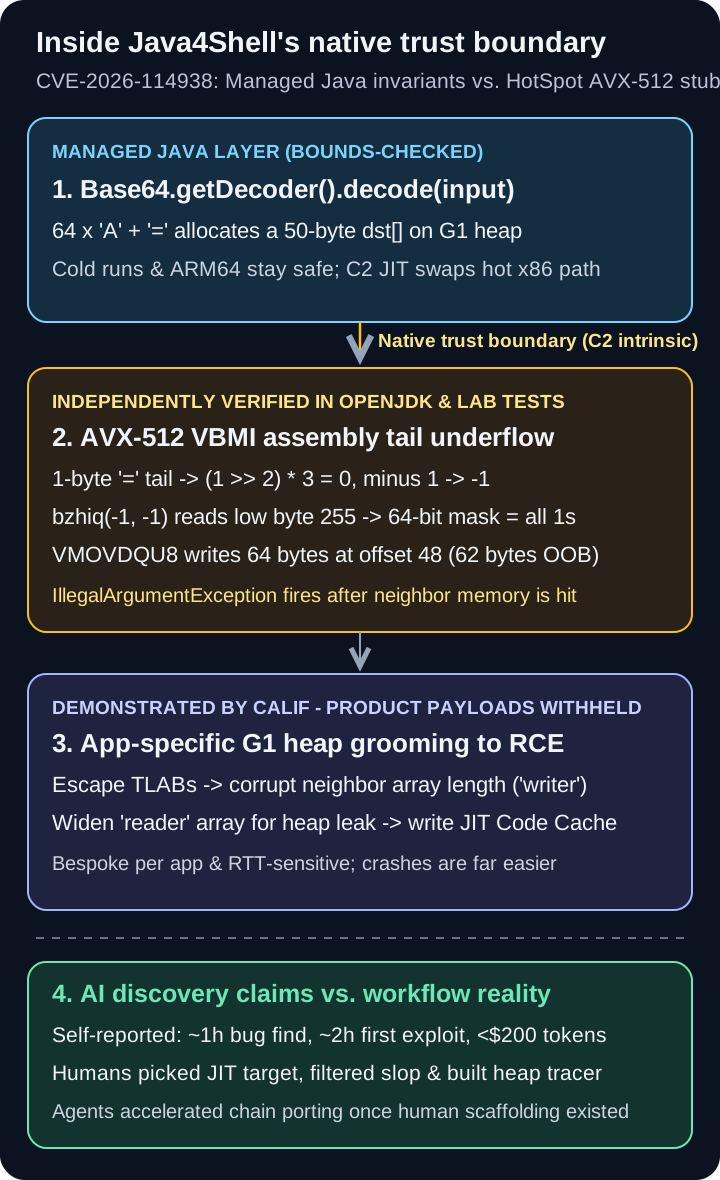
The managed layer allocates the right buffer size, but HotSpot's C2 intrinsic bypasses Java bounds checks on AVX-512 VBMI hardware.
Security reviews often treat Java's native boundary as third-party JNI libraries or Foreign Function & Memory (java.lang.foreign) calls. Java4Shell shows that the JVM's own speed optimizations sit on the unsafe side of that boundary too.
1. Hot code silently swaps bytecode for assembly
Calling Base64.getDecoder() or Base64.getUrlDecoder() (getMimeDecoder() bypasses the affected stub in tested builds) starts in safe bytecode. Once the method runs enough times, HotSpot's C2 JIT compiler replaces decodeBlock() with handwritten x86-64 AVX-512 VBMI assembly in stubGenerator_x86_64.cpp—raw machine code operating directly on Java heap pointers.
2. One unsigned mask assumption turns -1 into a 64-byte write
On JDK 21+, 64 'A' characters plus '=' (128 'A's plus '=' on JDK 17) allocate a 50-byte output array and leave a 1-byte '=' tail. The assembly tail handler computes (1 >> 2) * 3 = 0, subtracts 1 for '=' without checking for negative values, and feeds -1 into bzhiq to build the VMOVDQU8 write mask:
output_len = (tail_len >> 2) * 3;       // 1-byte '=' tail -> 0
if (has_padding) output_len -= 1;       // underflows to -1 (low byte 255)
output_mask = bzhiq(-1ULL, output_len); // 255 >= 64 -> all 64 mask bits stay 1
With all 64 mask bits active, VMOVDQU8 writes 64 bytes starting at offset 48, spilling 62 constrained bytes into whatever sits next on the G1 heap.
3. Java exceptions and developer hardware hide the flaw
After the assembly stub returns early, Java throws IllegalArgumentException as expected—but catching that exception cannot undo heap headers or array lengths already overwritten. Worse, ARM64 laptops, AWS Graviton servers, older x86 chips without avx512vbmi, and short unit tests that never trigger C2 compilation never execute the buggy path. Moving the exact same .jar or container onto an Intel Xeon (Ice Lake through Granite Rapids) or AMD Zen 4+ host quietly activates the vulnerable machine code.
What the case actually shows about AI-assisted discovery
Headlines naturally focus on "$200 and three hours," as CyberScoop reported. Calif's own technical narrative tells a more grounded—and more useful—story.
First, compact native boundary code is an ideal target for coding models. A few hundred lines of macro-assembler bit math (bzhiq behavior when a signed count underflows) is tiring for humans to read closely, yet self-contained enough for an LLM steered at JIT intrinsics to spot. Even there, Luong notes that most early model findings were unreachable "slop," requiring human judgment and ~20 minutes of persistent steering to separate a real primitive from noise.
Second, weaponization was human-engineered scaffolding plus AI iteration, not push-button autonomy. Turning a fixed-byte spill (0x9a / 69 a6 9a) into heap leaks and code execution required escaping HotSpot thread-local allocation buffers (TLABs) and shaping G1 regions over HTTP. Calif explicitly notes that the AI got stuck on heap grooming until researchers wrote a custom heap tracer and visualizer, designed classic writer and reader array-length primitives, and rented same-region cloud VMs to avoid network jitter. Only once humans built that pipeline did AI agents adapt chains across more applications.
For defenders, that middle ground is the real shift. AI does not abolish exploit complexity or network physics, but human-guided models sharply compress the time needed to audit low-level runtime glue—and to adapt working exploitation patterns across multiple enterprise products once a primitive is understood.
Practical takeaways for Java and runtime teams
- Patch runtimes everywhere they hide: Upgrade to fixed builds (
17.0.21.1,21.0.13.1,25.0.5.1,27.0.1.1, Oracle8u513-perf, and patched vendor distributions), scanning container layers and bundled appliance JDKs first on internet-facing identity and build systems such as Keycloak, PingFederate, Jenkins, Artifactory, Jira and Confluence. - Use the narrow JVM flag when patching waits: Restart affected services with
-XX:-UseBASE64Intrinsics(preferred) or-XX:UseAVX=2on x86-64 only—never addUseAVX=2to shared ARM64 configs, where the JVM will fail to start—and confirm live flags viajcmd <PID> VM.flags -all. Do not treat reverse-proxy buffering or current CPU models as permanent defenses; single-packet routes, WebSockets and node resizes can bypass them. - Fuzz intrinsics like untrusted C parsers: Whenever a memory-safe runtime replaces safe bytecode with SIMD assembly, C++ or
unsafeblocks, differential fuzzing across every input tail length and CPU feature flag belongs on that boundary.
Sources
- Calif Research: Java4Shell (CVE-2026-114938) technical disclosure
- OpenJDK Vulnerability Advisory: 2026/11/17
- Oracle Critical Security Patch Update Advisory — November 2026
- CISA Alert: Critical Java Vulnerability Requires Immediate Patching (Nov. 17, 2026)
- Datadog Security Labs: Java4Shell root-cause reproduction and mitigation analysis
- Qualys Threat Research Unit: Scope, affected builds and remediation guidance for CVE-2026-114938
- CyberScoop: Researchers disclose critical flaw in Java with help of AI
Hero photo: 5C2A5953R - 49913961083 – Silicon Wafer 20200519, by Rob Bulmahn, May 19, 2020. CC BY 2.0. Resized from 6720 x 4480 to 1920 x 1280 pixels and JPEG-compressed. This illustrative photograph shows integrated-circuit dies on a silicon wafer to represent CPU-level machine instructions beneath managed runtimes, not an affected OpenJDK server or the Java4Shell research setup. No endorsement is implied.
Discussion
One discussion for the English and Hebrew editions.
Loading comments...