The AI Pacing Suit: When Does a Shared Benchmark Become a Speed Limit?
Yoni Fraimorice
A shared test can help AI companies compare safety evidence. A shared promise to stop improving when a test reaches a certain score is a different kind of agreement.
An Associated Press report published on November 20 describes a federal antitrust suit against Anthropic, OpenAI, SpaceXAI, and Google. Four paid subscribers say the companies agreed to slow AI development, reducing the value of their subscriptions. The report says the companies had not responded to requests for comment. These are plaintiffs’ allegations, not court findings.
A date needs care: the November 20 date is the report’s publication date, not a verified filing date. A docket index lists the complaint as filed in September. I could not reach the court’s docket directly, so this article does not present November 20 as the filing date.
The case matters to engineers because a shared measurement can support independent choices—or help competitors agree when none will ship a better model.
What the September 12 exchange can show
The complaint points to a public sequence on September 12. Anthropic CEO Dario Amodei published “We Must Pace the Frontier”, arguing that AI capability gains should slow enough for safety work to catch up. That day, OpenAI CEO Sam Altman, SpaceXAI CEO Elon Musk, and Google DeepMind leader Demis Hassabis publicly expressed support for pacing.
The timing matters as evidence: the statements can show that leaders heard one another and knew others supported the idea. But public agreement with a safety goal is not, by itself, proof of a business deal; the posts could be independent advocacy. A court would assess the full record, including private commitments, a common plan, monitoring, or conduct that suggests the firms had agreed.
Under Section 1 of the Sherman Act, the issue is not whether rivals spoke about safety. It is whether they made an agreement that unreasonably restrained trade. Similar decisions made independently are not enough. The Supreme Court has said that parallel conduct alone does not establish an agreement; evidence must support an inference of a shared commitment.
The complaint says the alleged plan would slow model improvements. In a technology market, “output” can include product quality and capability, not just sales. A slower release schedule is not automatically illegal; the plaintiffs must prove an agreement and an unreasonable restraint. No court has ruled on this case.
A metric is not a cap
On November 22, OpenAI chief scientist Jakub Pachocki published a proposal to use perplexity as a shared way to compare models. Perplexity, or cross-entropy loss, measures how well a model predicts the next token in text. Pachocki argues that comparing the measure across developers could inform shared safety standards.
That proposal makes the distinction easier to see:
- A common measuring stick lets teams report results in comparable terms. Each company can still choose its own training plan and release date.
- A common gate says no company will pass a defined score or capability level until some shared safety condition is met. That can affect when competitors improve or release products.
The second arrangement may raise more antitrust concern if companies privately agree to limit competition. The first is not automatically safe in every design, and the second is not automatically illegal in every context. Purpose, market effects, details, and safeguards matter. Perplexity is also only one measure of language-model performance; it does not capture every ability or safety risk. OpenAI’s post proposes a metric for comparison and standards. It does not, by itself, establish an agreement to freeze model progress.
The public, same-day exchange is one piece of evidence, not the whole case. It does not show that the companies adopted a binding ceiling or delayed a model release because of one.
What government involvement changes
Amodei’s essay recognized the legal risk and suggested that government could mediate safety discussions or grant a narrow antitrust waiver. Those options are not the same as competitors deciding privately to slow down.
A government can set a rule that applies to all covered companies, explain the safety basis in public, and define how compliance is checked. A waiver, if legally granted, could protect only the conduct and limits it clearly covers. A meeting with officials, or government support for a general safety goal, does not automatically make every private agreement lawful.
That distinction matters because the FTC and Justice Department withdrew their 2000 guidance for competitor collaborations in 2024, saying it no longer gave reliable guidance. They said collaborations would be assessed case by case.
The AP report also mentions brief social-media references by President Trump to an AI task force and an “AI czar.” It provides little detail, so those posts should not be treated as an established government pacing program.
The practical boundary
For AI teams, a useful boundary is to share how to test safety while keeping whether and when to ship an independent company decision. Public test methods, incident formats, and independent evaluations can make safety evidence easier to compare. Private promises about launch dates, capability ceilings, or how much to train can constrain the competition the law is meant to protect.
That is not a legal safe harbor. The lawsuit is unresolved, and the full facts matter. The larger lesson is that a benchmark can be neutral infrastructure, while the rule attached to its score can change how firms compete. A transparent government rule or a carefully scoped legal exemption would provide a different basis from a private pact—but neither should be assumed from a public statement alone.
Sources
- Associated Press report via KRGV — the allegations, subscriber plaintiffs, September 12 exchange, and company comment status.
- CourtListener docket index: Buist v. Anthropic PBC — lists the case and September complaint date; the court’s docket could not be reached during this research.
- Dario Amodei: “We Must Pace the Frontier” — the September 12 essay and its request for government involvement.
- OpenAI: “Perplexity and Intelligence” — Pachocki’s proposal for perplexity as a cross-developer comparison metric.
- FTC and DOJ: withdrawal of the 2000 competitor-collaboration guidelines — confirms that collaboration reviews are now case by case.
- Bell Atlantic Corp. v. Twombly, 550 U.S. 544 (2007) — parallel conduct alone does not establish an antitrust agreement.
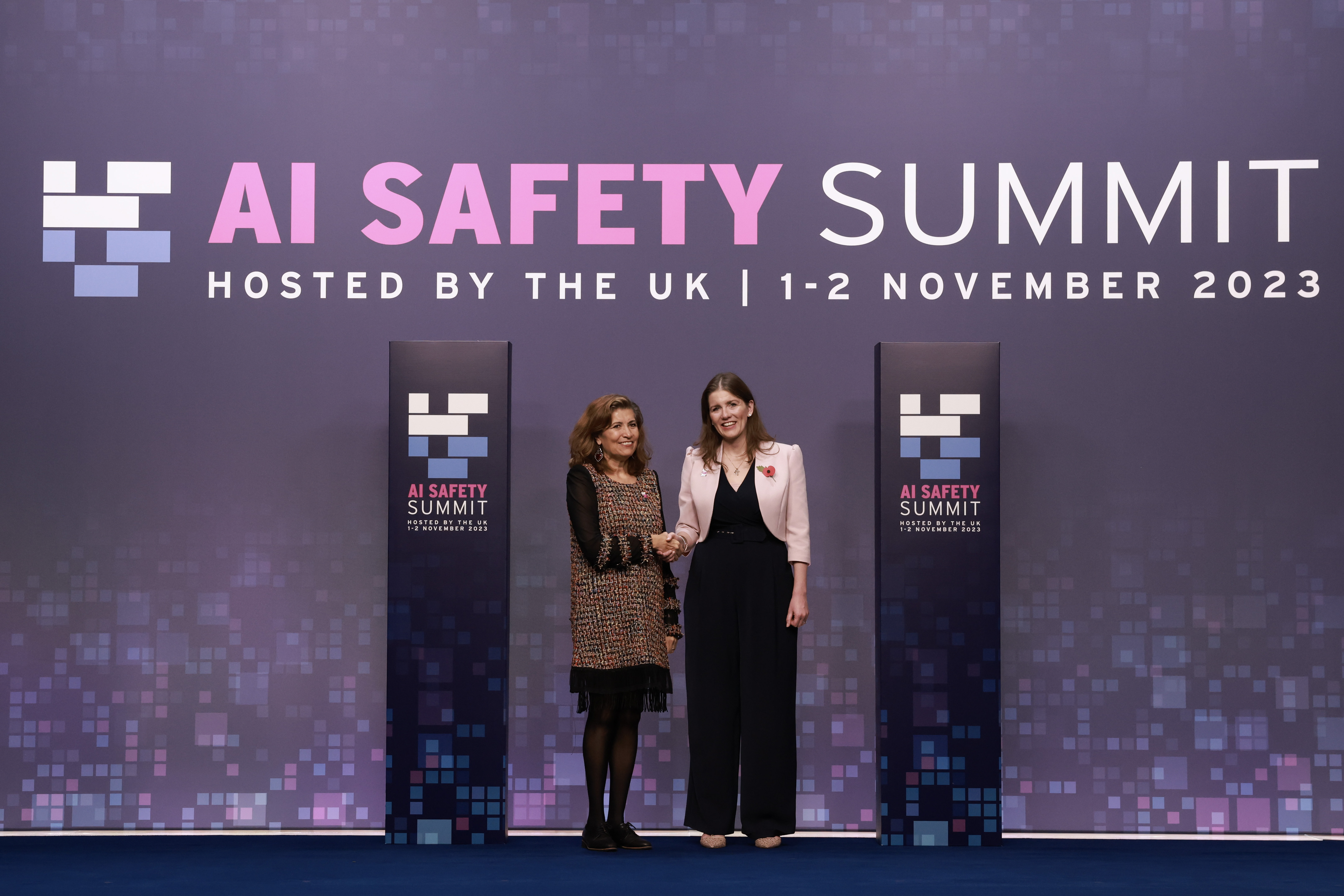
Hero photo: UK Government hosts AI Summit at Bletchley Park (53301276157), by Lauren Hurley / No 10 Downing Street. Open Government Licence v3.0. Original 6431 × 4289 pixels; used without edits. This archival summit photograph is illustrative and does not depict the lawsuit or the companies involved.
Discussion
One discussion for the English and Hebrew editions.
Loading comments...