Fireworks AI breach: what Uber, Notion and Cursor confirmed
Yoni Fraimorice
A vendor can expose your data in different ways. An attacker might enter your account at the vendor, steal a dataset the vendor holds, or use a key you gave it to reach your storage.
The Fireworks AI disclosures now involve all of these patterns. Uber, Notion and Cursor have confirmed exposure, but their accounts describe different systems and data.
As of November 16, the public evidence does not establish one attack chain connecting all three customers. The access paths matter more than a shared vendor name.
What Fireworks disclosed
Fireworks' October bulletin describes unauthorized use of internal credentials detected on October 6. Attackers captured environment variables from evaluation jobs in a limited number of accounts, including API keys and tokens.
Its November 9 update describes further activity. A cloud provider hosting Fireworks research machines suffered an incident on October 23. On October 24, attackers used that access to reach Fireworks development machines and run an unauthorized workload.
The update reports exposure of resource metadata, billing information and, for certain customers, datasets and incomplete model weights. Payment card numbers were not affected. Fireworks says it found no impact to Inference, Training SDK or Nexus.
Neither bulletin names Uber, Notion or Cursor, or maps each customer's exposure to a particular intrusion.
Three customers, different access paths
| Company | Disclosed access path | Confirmed or reported exposure |
|---|---|---|
| Uber | Compromised provider credentials opened Uber's account at the provider | Personal information confirmed by Uber; driver's license information reported from notices |
| Notion | Vendor-held data was accessed; the entry mechanism remains undisclosed | Selected AI chats used by Insights, affecting fewer than 1% of workspaces |
| Cursor | A Cursor-issued key exposed at Fireworks opened a shared read-only bucket | Historical coding traces, then credentials and selected internal SaaS data |
These are company disclosures, not independent forensic reports. The table keeps their stated scope separate.
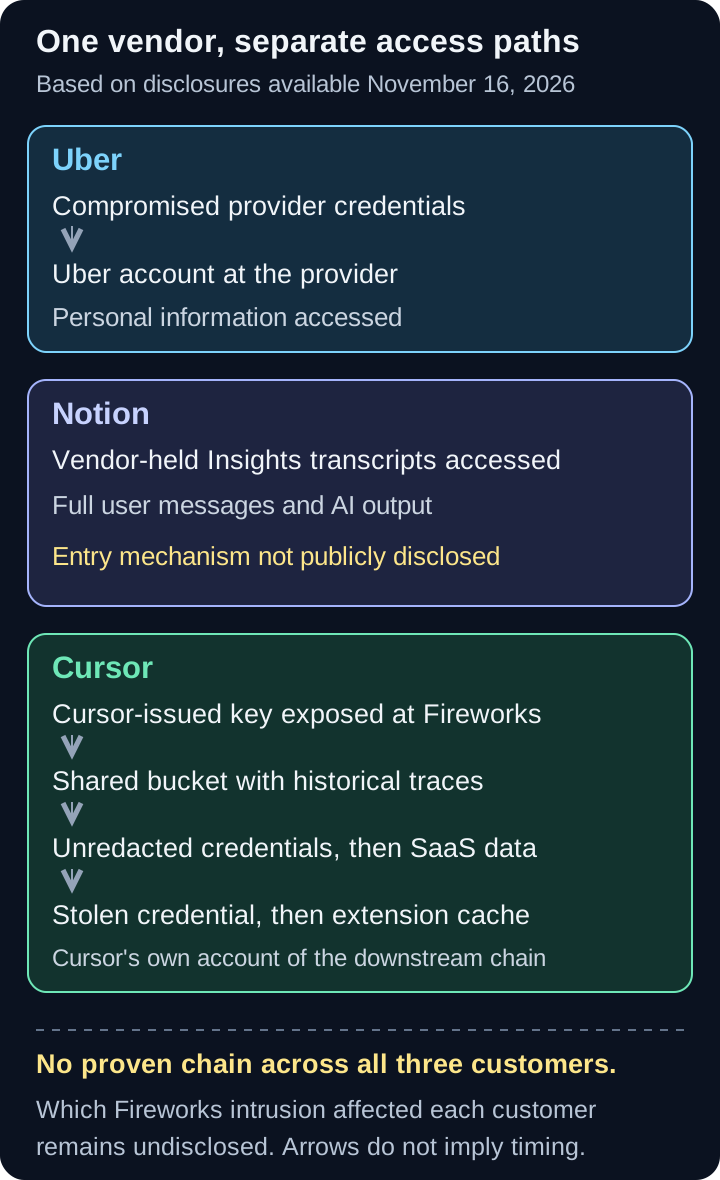
The arrows show paths described by the companies. They do not connect the customers or assign them to a specific Fireworks intrusion.
Uber confirmed provider-account access
Uber's November 10 notice filed with California's attorney general says a provider notified it on October 9. Attackers had compromised the provider's internal credentials and used them to access Uber's account with that provider.
Uber immediately severed its data connections. On October 13, its investigation confirmed access to personal information connected to the provider.
The public template leaves the exact data fields as placeholders. TechCrunch's November 13 reporting identifies driver's license information in notices covering thousands of people. An Uber spokesperson named Fireworks as the vendor. A national total remains undisclosed.
This does not establish a break-in to Uber's production network. The public notice does not explain where the data was stored, why Fireworks could access it, or which credential type was compromised.
Notion exposed chats, not an entire workspace
Notion's advisory says fewer than 1% of workspaces were affected. The data included AI chat transcripts used by Insights, a feature that analyzed AI usage. Notion says its own systems were not breached.
Its detailed FAQ explains what "unattributable" means. Most affected transcripts lacked automatically added author and workspace metadata. That does not make their contents anonymous.
Full user messages and AI responses were included. Messages could contain names, email addresses or API tokens. Selected page text and material quoted by the assistant could also appear. For most affected transcripts, tool-call results were absent. This was not exposure of every page or attachment in a workspace.
Notion disconnected Fireworks on November 3. Its revised timeline records deletion of vendor-held data on November 4 and confirmation of the affected dataset on November 8. Those are response dates, not a disclosed theft date.
On November 11, Notion revoked its own exposed API keys. On November 12, it reported exposed third-party keys to their issuers.
Cursor documented a longer credential chain
Cursor's November 13 account gives the clearest sequence.
An attacker obtained a key that Cursor had issued to Fireworks. This was a customer-issued key exposed at the vendor, not simply a Fireworks login. It allowed reads from a bucket used to share data.
The bucket held coding-agent traces, mostly from 2025, from sessions outside Privacy Mode. Traces affected fewer than 0.05% of users. Unredacted API credentials appeared for fewer than 0.01% of customers. These percentages measure different things.
Cursor says those credentials opened selected SaaS tools. Exposed material included archived non-production repositories, limited support data, business contacts, usage metrics and conversation summaries.
A stolen credential from exposed internal data then let the attacker place malicious Claude Code extensions in Cursor's marketplace cache on October 29. Cursor says Open VSX never hosted the malware. At most 5,000 users potentially received affected builds during roughly 11 hours.
Cursor excludes Privacy Mode prompts and code, customer repositories, production systems and official app updates. The exclusion of customer repositories does not mean historical trace content was safe.
Affected users should follow Cursor's extension notice. Uninstalling alone may not remove persistence.
What remains unresolved
The disclosures do not identify which Fireworks intrusion exposed each customer's data, or prove that all activity involved one actor. They do not establish an employee-account, SSO or stolen-session mechanism.
Fireworks' early statement that it had found no personal-information exposure within its control also remains unreconciled with Uber's later notice.
Fireworks' October 25 containment statement concerns its platform. It does not mean every downstream effect ended then. Cursor reports blocked attacker activity as late as November 1.
Controls supported by the evidence
Start with credentials issued to vendors. Cursor's read-only key still allowed data theft. Use separate identities per vendor and task, narrow dataset access, prefer expiring credentials and apply network restrictions where supported. Log reads as well as writes.
Scan traces, support exports and evaluation datasets before sharing them. Repository scanning alone misses credentials inside conversations. Notion's and Cursor's disclosures show that ordinary text can contain usable secrets.
Revoke credentials with their issuers. Fireworks explicitly warns that deleting a stored secret does not invalidate the key. A response inventory should identify each exposed credential's owner, permissions and revocation path.
Check retention by feature and endpoint. Notion distinguishes retained product history from zero-retention model requests. But its FAQ also says Fireworks contractually promised zero retention and retained data anyway. Scope matters, and so does verifying that the provider follows the agreement.
Finally, rehearse disconnecting a vendor without waiting for a complete incident report. Uber severed connections, Notion stopped sending data, and Cursor revoked shared access. These actions support a practical response plan. They do not prove that multi-factor authentication alone would have stopped the disclosed attacks.
Sources
- Fireworks October security bulletin
- Fireworks November 9 update
- Uber public notice filed with California's attorney general
- TechCrunch's Uber reporting and spokesperson statement
- Notion security advisory
- Notion's detailed exposure and retention FAQ
- Cursor November 13 incident update
- Cursor malicious-extension notice
Hero photo: Uber offices, Mission Bay, July 2020, by HaeB, July 17, 2020. CC BY-SA 4.0. Resized from 4032 x 3024 to 1920 x 1440 pixels and JPEG-compressed. The adapted photograph is shared under the same license. This archival photograph shows Uber's San Francisco offices, not the breached systems or evidence of the incident. No endorsement is implied.
Discussion
One discussion for the English and Hebrew editions.
Loading comments...