European Commission cyberattack: AI use, not proven autonomy
Yoni Fraimorice
An attacker asking AI to explain an error and an agent choosing its next action are different things. Both involve AI. Only the second shows some independent control.
On November 19, the European Commission confirmed that attackers had misused an AI tool. That matters. But the public evidence does not yet establish an autonomous campaign.
This analysis uses information available on November 20, 2026. The investigation remains open. Official statements establish what the Commission has said; they are not a published forensic audit.
What the Commission actually confirmed
The strongest source is the Commission's own briefing and transcript, rather than a headline.
Spokesperson Thomas Regnier gave two dates: detection on October 22, followed by confirmation after an initial investigation on October 26. Neither date necessarily marks the attacker's first access.
The Commission temporarily took several applications offline as a protective measure. Most had been restored by the briefing. Regnier described several incidents within a campaign and said many elements had been contained. He did not declare the campaign over.
He called it an "AI generated cyber campaign" and confirmed misuse of a publicly available AI tool. He did not name the tool, its model provider, the entry vulnerability, or the attacker. He also declined to disclose the Commission's defensive tools.
On staff information, his wording was narrow: the investigation had found no evidence of a breach affecting Commission staff "as a whole." This is not a guarantee that no individual's data was accessed. Nor does an unfinished investigation prove that theft occurred.
Reuters' report preserves those limits. Regnier also said he was not aware of a ransom demand. That is not evidence that every attacker objective is known.
Contested reporting is not the same as disproved reporting
POLITICO's November 19 investigation described a huge attack, possible exposure of large amounts of personal data, and disruption lasting over ten days.
It named Sysper, used for HR tasks, and MyPMO, used for medical reimbursements. It also reported translation-service disruption and senior crisis meetings, drawing on officials and an internal email.
These details need careful labels:
| Claim | What the available sources support |
|---|---|
| A huge or exceptionally large attack | POLITICO's description; Regnier declined to assess its scale while the investigation continued |
| Large-scale staff-data theft | A reported possibility, not confirmed theft; the Commission's limited assurance does not rule out narrower exposure |
| Named applications and ten-day disruption | Reported by POLITICO; the briefing confirmed temporary shutdowns without naming services |
| ARTEX was used | Reported by POLITICO, but not named by Regnier in the briefing |
This is a contested account of scale and an unresolved account of impact, not a clean official denial of the entire story.
Also, taking an application offline to contain risk does not prove that the attacker compromised that application. Availability loss, unauthorized access, and data theft are separate findings.
A reporter asked about a Chinese AI tool. Regnier did not confirm that description. A question is not an answer, and a tool's origin would not establish the attacker's nationality anyway.
ARTEX makes autonomy plausible, not proven here
CERT-EU's November 5 advisory describes ARTEX as an LLM-driven penetration-testing framework. It says similar activity against the EU bodies it protects highly likely involved ARTEX. That is useful context, not a public forensic identification of this Commission campaign.
According to CERT-EU, ARTEX can turn an objective into tasks and run testing tools through agent workers. But it also has a dashboard for human steering and an approval queue. It uses external models, and capabilities can differ between forks. CERT-EU warns that its scope rules are not hard technical enforcement.
Therefore, even a verified ARTEX installation would not tell us which model ran, which actions needed approval, or how often an operator intervened. Product capability is not evidence of how someone used it.
What would justify calling it autonomous?
For this analysis, use three levels. These are working definitions, not an official incident classification:
- AI assistance: a person uses generated text or code and chooses the operational steps.
- Autonomous activity within a stage: an agent chooses, executes, and adjusts actions within a defined task without a person directing each step.
- Campaign-level autonomy: that control continues across the campaign stages being claimed, with human involvement clearly documented.
A person setting the initial objective does not rule out later autonomy. Equally, one independent scan does not make an entire campaign autonomous. AI-assisted operations can contain autonomous stages. Autonomy and success are separate: an agent can act independently and still fail.
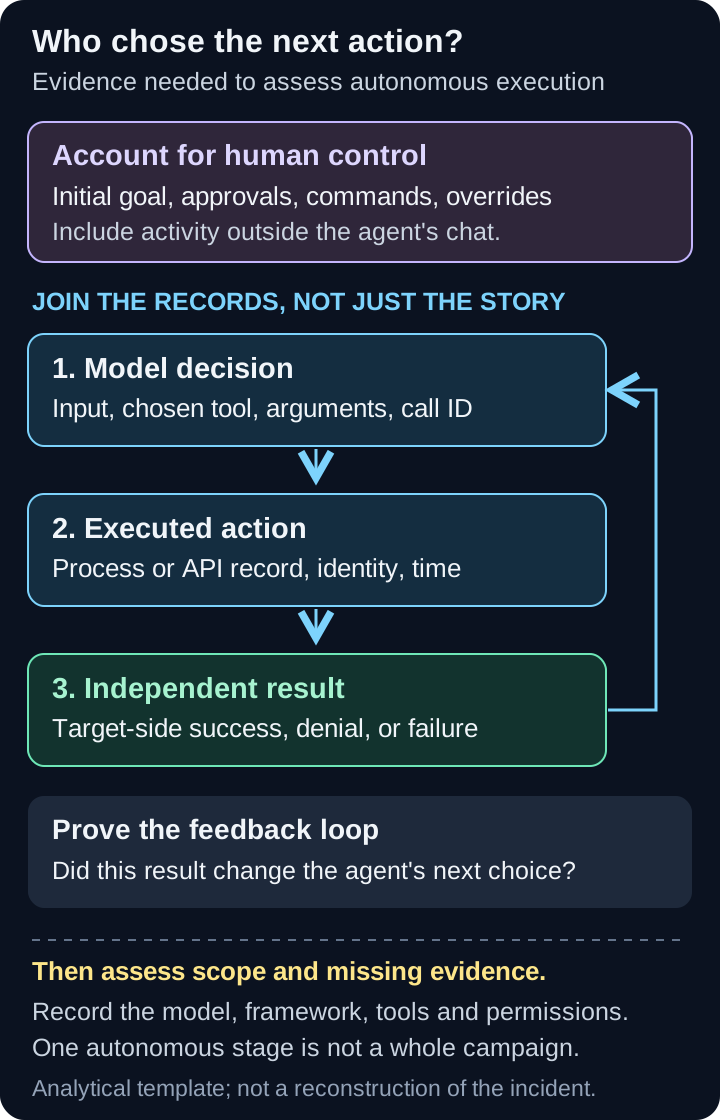
An analytical evidence model, not a reconstruction of the Commission attack. The public briefing does not provide these traces.
To support the stronger claim, investigators would need:
A decision-to-action trace. Link model requests and tool calls to actual process or API execution, then to target-side events. Use timestamps and correlation IDs. A generated command is not proof that it ran.
Evidence of feedback and adaptation. Show that a result reached the agent and changed its next action. For example, in an authorized test, an access denial might cause an agent to choose a different permitted check. A fixed retry script is automation, but does not by itself show AI decision-making.
A record of human control. Preserve operator messages, approvals, manual commands, pauses, and overrides. A quiet chat window cannot rule out intervention through another console or service.
The actual runtime configuration. Identify the framework version or fork, model, tools, permissions, and approval settings used during the incident. A default configuration or marketing page is not enough.
Independent outcomes and coverage. Match claimed access or data transfer to identity, endpoint, application, and network records. Document missing logs and clock differences. Preserve original records, integrity hashes, and their handling history. An agent's success report is a lead, not a verdict.
The assessment should state which stages and time window it covers. Protected records can be reviewed by an independent investigator without publishing credentials or victim data. Private model reasoning is not required: the evidence must connect decisions, actions, results, and human involvement.
What defenders can do before that answer arrives
CERT-EU recommends reducing internet exposure, isolating management interfaces, patching exposed assets, and monitoring privileged activity. It also warns against ignoring low-severity findings that automated tools can combine.
For incident response, preserve authentication and application logs alongside endpoint and network records. Keep evidence of failed actions too. If agent-side records become lawfully available, join them to those independent observations rather than trusting their narrative.
The supported conclusion is AI-tool misuse against the Commission. Autonomous execution remains a question about control and evidence, not a synonym for speed, scale, or an AI product name.
Sources
- European Commission: November 19 briefing, cybersecurity Q&A and transcript
- Reuters: Commission confirmation and investigation limits
- POLITICO: original reporting on disruption, possible exposure and ARTEX
- CERT-EU: ARTEX advisory, November 5
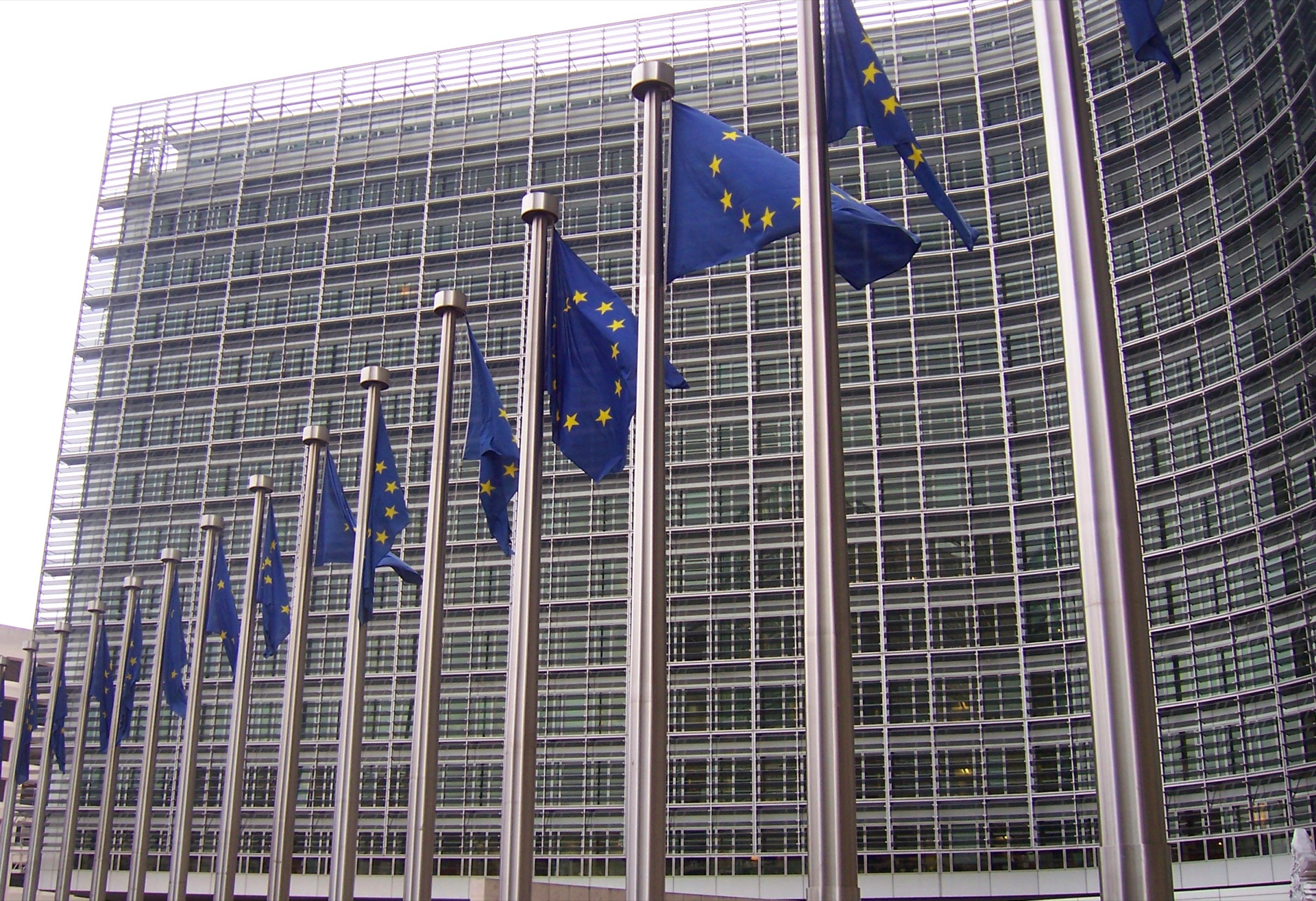
Hero photo: Banderas europeas en la Comisión Europea, by Amio Cajander, October 26, 2007. CC BY-SA 2.0. Resized from 2405 x 1647 to 1920 x 1315 pixels and JPEG-compressed; displayed with responsive cropping. The adapted photograph is shared under the same license. This archival photo shows EU flags outside the Berlaymont, the Commission's Brussels headquarters, not the attack or affected IT systems. No endorsement is implied.
Discussion
One discussion for the English and Hebrew editions.
Loading comments...