
AWS Cairn: what the successes and failures actually prove
Yoni Fraimorice
One AI-agent run spent roughly 16 hours failing to take over a server. Another found a dangerous file-write flaw in about 11 minutes. Both outcomes appear in AWS's November 20 Cairn report.
That contrast matters more to defenders than the headline alone. Autonomous activity can be persistent and effective without being reliable, universal, or free of human control.
This analysis reflects the sources available on November 21, 2026. The reported activity happened in September, not this week.
Start with where the evidence came from
On September 10, Amazon Threat Intelligence found a publicly accessible Cairn instance with no authentication. Cairn is an open-source framework that coordinates AI agents around a task. The exposed instance revealed project configurations, operator prompts, AI output, and operational history.
AWS describes an approximately 48-hour campaign beginning September 8, targeting university IP addresses in East Asia outside mainland China. The operator supplied targets and variations of the goal "obtain shell access."
These are AWS's findings from an attacker-controlled system, not a complete public archive of victim-side logs. The report is useful operational evidence, but readers cannot independently verify every outcome from the published material alone.
AWS says the affected organizations were not AWS customers. It worked with a government partner to notify them. This is not a report of a breach of the AWS platform.
Compare the runs, not just the winning example
| Operation | What AWS reports | Outcome and limit |
|---|---|---|
| Exposed Redis service and nearby systems | Roughly 16 hours and 148 sequential actions, with repeated changes of approach | No successful takeover; internal network mapping still exposed information |
| University GPU server and other university services | More than six hours, about 80 researched usernames, and over 30,000 credential combinations | No working login found |
| Medical-imaging AI application | About 11 minutes from API mapping to arbitrary file writing; a later session achieved command access as root | A reported compromise; 11 minutes was not the measured time to full server control |
The Redis case deserves careful reading. Access without authentication was dangerous, but it did not automatically become control of the host. The agents also obtained internal network information through a nearby service. A failed overall objective can still include damaging intermediate progress.
The login operation shows another limit. Patient research and thousands of attempts did not produce a valid credential.
These are selected examples, not a complete benchmark. Counting one success and two failures does not give Cairn a measured success rate.
Keep observations, assessments, and inference separate
Zero-day: AWS's high-confidence assessment. AWS says the medical-imaging flaw was unpatched at discovery, with no corresponding fix, issue, advisory, or earlier vulnerability-database mention. That supports its assessment of an unknown vulnerability at that time. It does not prove that nobody had privately found it before, or that the underlying class of bug was new.
Attribution: AWS's moderate-confidence assessment. The indicators were Simplified Chinese prompts, script timestamps configured to China Standard Time, and targeting that AWS considered strategically relevant to China. These clues support an intelligence judgment, not a proven operator identity, government sponsorship, or model-provider nationality.
The second university: an explicit inference. In a later session, a human supplied a proxy into another university network and directed further activity. AWS infers that the actor had used the newly found flaw to establish that access because the connected server ran the same vulnerable software. The supplied access and instruction are described in the records; the preceding compromise through that flaw is inferred.
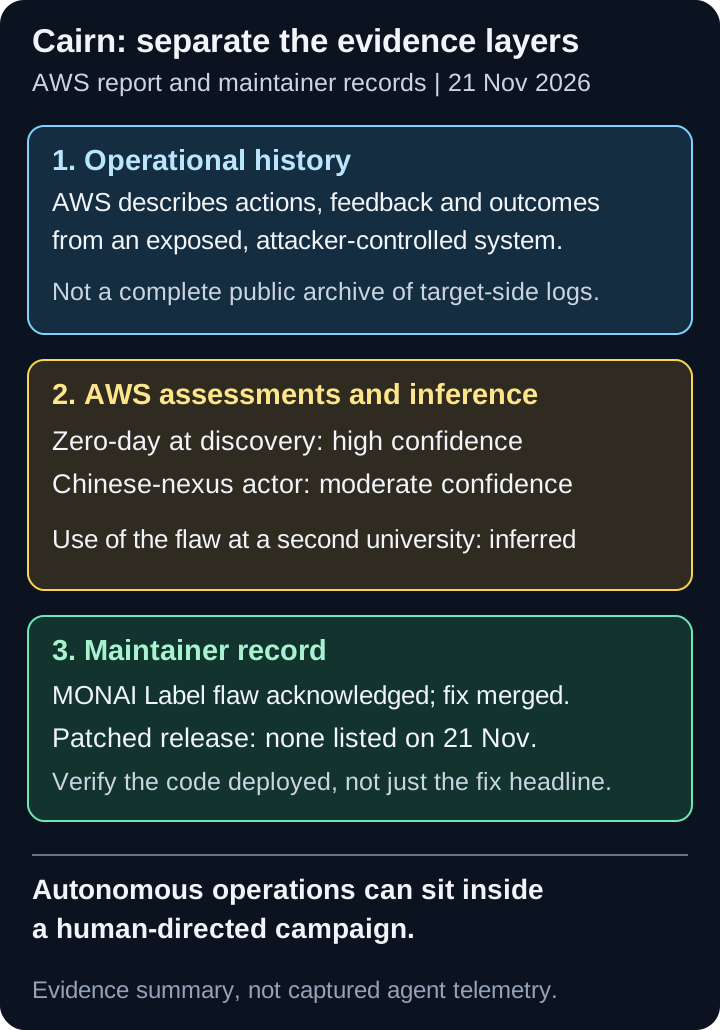
A summary of evidence categories, not captured Cairn telemetry. The patch-status note reflects the advisory as checked on November 21.
What this establishes about autonomy
AWS says the agents planned, executed, and adjusted their actions without the operator choosing each next step. Together with the long failed runs and the successful discovery, this supports goal-directed autonomous execution within operations, not merely AI-written advice for a person to execute.
But the human chose the targets and goals, then supplied new access and direction later. Autonomy during an operation is compatible with human control of the campaign. It does not mean the agents chose their own mission.
The report does not name the underlying model or provide a complete denominator for success rates. It also does not establish that agents can reliably defeat well-defended systems. The failures are evidence against that sweeping claim, not evidence that autonomous attacks are harmless.
For an independent assessment, investigators would want linked tool-execution records, server file and process events, network activity, and operator interventions. They should document missing time windows. An agent's success message alone is weaker than a matching event on the target.
A source fix is not a patched release
The maintainer advisory identifies the affected application as MONAI Label, a medical-imaging AI tool. It lists versions 0.8.5 and earlier as affected.
The issue allowed uploaded content to be written outside the intended storage area. The maintainers' fix checks that destination paths stay inside that area. This is a storage-boundary failure, not evidence that a medical AI model itself was compromised.
There is an important delivery detail. Project-MONAI/MONAILabel#1915 merged on October 19. Yet, when checked on November 21, the advisory still listed no patched release version and said the fix would be in the next release.
AWS's statement that maintainers released a fix should not become an assumption that an ordinary package upgrade already contains it. Verify the deployed build or supported backport against the maintainer's fix.
Until that is confirmed, follow the advisory's precautions: restrict network reachability, enable authentication, limit the ANNOTATOR role to trusted users, and run the service without administrator privileges, with tightly limited write access. Authentication reduces exposure; it does not repair the flaw.
Turn these findings into defensive actions
OWASP's upload guidance recommends generated filenames, authorized uploads, separated storage, and layered validation. Keep writable data away from application code and runtime files. Restrict outbound access from research workloads too.
For detection, connect events across layers. An upload followed by an unexpected write, a new process, and an unusual outbound connection is more useful than an isolated warning. Preserve those records before containment destroys useful evidence.
Aggregate failed logins across accounts and services, not only one source address. A long unsuccessful run creates opportunities to detect and stop activity, even when it never reaches its final goal.
Pre-authorize narrow, reversible responses to high-confidence evidence, with human oversight for disruption and recovery. Do not shut down an important service solely because traffic volume increased.
The lesson is neither “AI can hack anything” nor “the failures make it safe.” Reduce what an exposed service can reach, verify that fixes reached production, and make defensive decisions from correlated outcomes rather than an agent's claims.
Sources
- AWS: Cairn campaign findings, November 20, 2026
- MONAI Label advisory: affected versions, patch status, and precautions
- Project-MONAI/MONAILabel#1915: merged storage-path fix
- OWASP File Upload Cheat Sheet
Hero photo: The CSIRO GPU cluster at the data centre, ScienceImage 11313, credited to CSIRO, April 19, 2010; no individual photographer is named on the source page. CC BY 3.0. Resized from 2657 x 1764 to 1920 x 1274 pixels and JPEG-compressed; responsive display cropping. This archival research-computing photograph illustrates the GPU-server target class. It does not show AWS, Cairn, or any affected university, and does not imply CSIRO was targeted or endorses this article.
Discussion
One discussion for the English and Hebrew editions.
Loading comments...