OpenRouter's provider purge: canaries put ZDR to the test
Yoni Fraimorice
A privacy setting can decide where a prompt should go. It cannot, by itself, prove what happens after arrival.
On November 22, OpenRouter announced that it had offboarded three providers, removed 125 endpoints from Zero Data Retention (ZDR) eligibility, and notified potentially affected customers.
That is not 125 proven breaches. Some removals were precautionary. OpenRouter says the findings did not show a breach of OpenRouter itself.
The trigger was Dragos research published on November 19. Its central lesson is not that every provider leaks. It is that privacy promises need checks against actual behavior.
What the two million prompts measured
From July through November 2026, Dragos sent approximately two million prompts containing unique URLs and canary credentials across AI services. This was not a count of affected users, breaches, or exclusively OpenRouter requests.
Each planted value could be linked back to its prompt, model, router and privacy setting. The researchers monitored controlled services. Their AWS keys belonged to empty accounts with full logging.
Dragos described three distinct findings:
- Provider compromises: planted credentials from at least three providers were used against controlled systems. Bait AWS keys generated tens of thousands of API calls. Some came from requests rejected before inference, supporting Dragos's assessment that copying occurred at the provider's entry point.
- Reseller access: marketplace sellers could collect prompts through ordinary request logging. Follow-on browser and login activity showed the planted data being used, without needing a platform exploit.
- Policy failures: an unnamed Chinese AI lab's systems fetched secret URLs from roughly two-thirds of tested requests marked no-data-collection or ZDR. Fetches commonly arrived two or three days later, including after requests through U.S. hosts.
These are researcher-reported observations, not an independently audited census of the industry.
A callback is evidence, not the whole story
Credential misuse is stronger evidence of exposure than a URL fetch alone. Link previews, security scanners and authorized image retrieval can also generate callbacks. A delayed fetch shows that a planted value remained available somewhere; it does not, alone, prove model training or identify who stored the full prompt.
Dragos also described a full secret link appearing in a company chat 24 days after a ZDR request. Its disclosure had included only the link's first eight characters. That supports its assessment of retained prompt access more strongly than an unexplained web request.
To investigate routing, the team combined controlled image fetching with error-response analysis. Across about 2,000 traced routes, several hundred contained unidentified systems; a handful involved an unadvertised company fetching the image.
Unidentified is not automatically malicious. Fetching IPs and error signatures help investigate a path, but do not reveal every processor or prove where the leak occurred.
Why the ZDR label was not enough
The provider notices describe different failure mechanisms:
| Provider disclosure | Mechanism and evidence boundary |
|---|---|
| Novita | A routing configuration sent some MiniMax requests to MiniMax's API instead of Novita infrastructure. URL and hostname accesses were observed, but not AWS test-key use. Automated content review remains an assessment under verification. |
| Phala | A compromised inference VM exposed in-flight data. Canary misuse involved October 21–22 requests, but Phala kept a precautionary exposure window through November 8, 05:35 UTC, because sampling cannot bound all access. |
| Together AI | A leaked repository credential enabled downloading stored testing samples from June and July. Five tested credentials were Dragos canaries. Together says sample collection was authorized; its notice does not establish that these requests had ZDR enabled. |
OpenRouter links these notices, but does not identify this list as the three offboarded providers. Do not equate every named incident with every unnamed Dragos finding.
Three controls were being confused: a retention promise, correct routing, and a secure runtime. A provider can forward data outside the promised path. A logging system can keep it. An attacker can copy it during processing even if routine storage is disabled.
The label also needs a precise definition. OpenRouter's current ZDR documentation says provider.zdr: true can admit Safety Retention endpoints when account or guardrail settings allow them. Strict users need the ZDR only choice. No training does not mean no retention.
The documentation excludes in-memory prompt caching from its retention definition, describes a CSAM-related retention exception, and puts plugins and tools outside the inference-routing filter. These documented boundaries do not explain away secret theft, or establish which settings applied to each historical test.
Turn canaries into an audit control
OpenRouter says it is adapting the research for ongoing checks, verifying network paths, and requiring assurances and validation before restoring removed endpoints' ZDR eligibility.
That is a direction, not yet a published universal audit standard. A useful standard could require five things:
1. Measure routes, not brand names. Sample each model, endpoint, region, privacy setting and fallback path. Record policy versions, requested settings and the route actually selected. Include rejected requests: data can escape before inference succeeds.
2. Use safe, controlled probes. Send synthetic content through authorized tests. Give every probe unique markers. Canary systems must not expose customer data or permit paid resource creation. Keep never-submitted markers as negative controls and known legitimate fetches as positive controls. Separate expected image retrieval from unexpected access to a secret URL.
3. Preserve evidence and investigate. Record timestamps and callback types, not just a red alert. Compare against scanners, tools and disclosed subprocessors. Join observations with gateway and provider logs. Monitor older markers for delayed use, but remember: reuse of an already leaked token after containment does not prove a new leak.
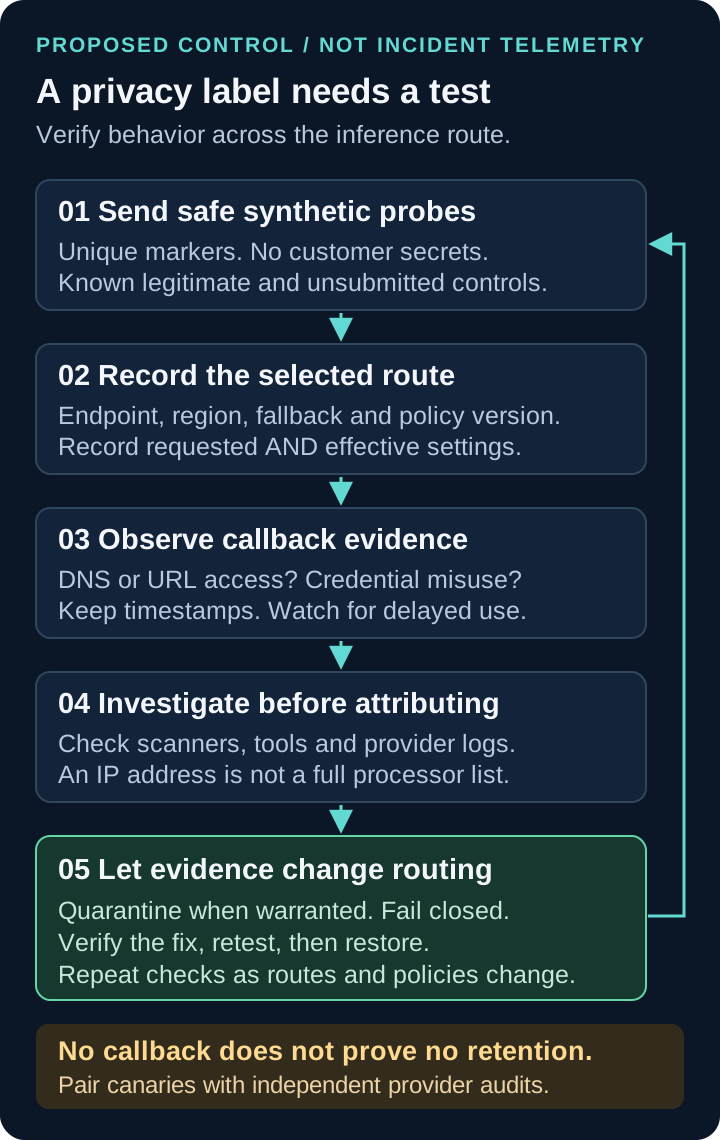
Proposed control design, not captured OpenRouter traffic. A signal starts an investigation; silence is not proof of zero retention.
4. Make findings change routing. Quarantine implicated routes when evidence warrants it, preserve records, and notify affected customers. Using provider allowlists and fallback controls, keep traffic inside the approved policy. If no eligible route remains, fail closed rather than silently relaxing privacy. Reinstatement needs a verified fix and fresh tests, not only a new promise.
5. Publish coverage and response metrics. Report routes tested, sample counts, observation windows, unexplained hits, and time to investigate and quarantine. Preserve an evidence package for independent review. Pair canaries with access-control, logging, deletion and subprocessor audits.
A provider that silently stores prompts and never touches a planted value may produce no callback. Detectable misuse is only part of the risk.
Continuous testing can falsify a privacy promise. It cannot, on its own, certify that the promise is always kept. That makes canaries a valuable audit control, not a replacement for the rest of the audit.
Sources
- Dragos: methodology, observations and disclosure limits
- OpenRouter: provider actions and planned verification
- Novita: MiniMax request privacy notice
- Phala: preliminary incident report and sampling limits
- Together AI: stored prompt-sample exposure
- OpenRouter: ZDR scope and policy choices
- OpenRouter: provider routing controls
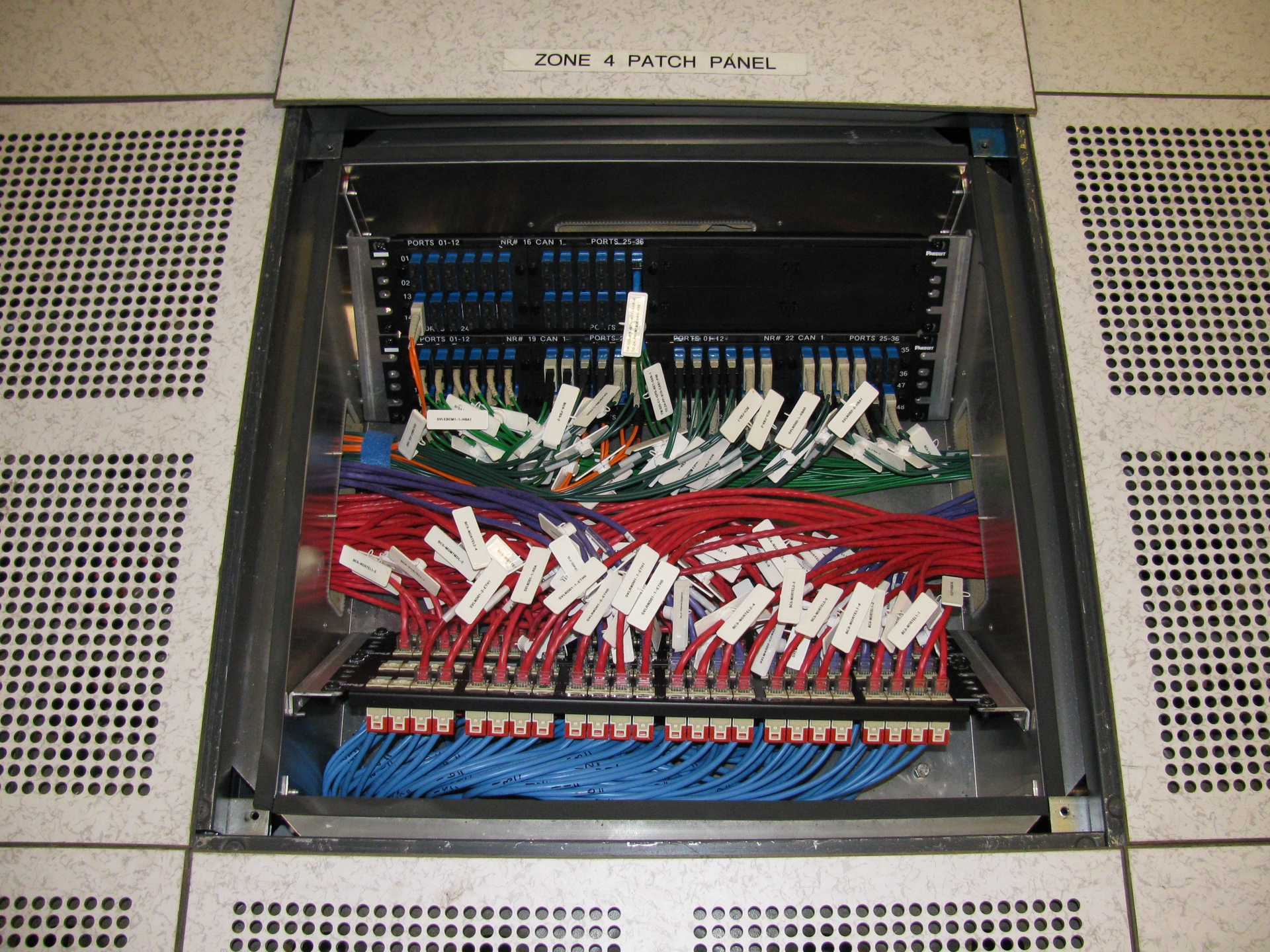
Hero photo: In Floor Patch Panel Fiber, by Robert.Harker, 2012. CC BY-SA 3.0. Resized from 3456 x 2592 to 1920 x 1440 pixels and JPEG-compressed. The adapted photograph is shared under the same license. This archival network-interconnect photograph illustrates routing and connection visibility; it does not show OpenRouter infrastructure or evidence of these incidents. No endorsement is implied.
Discussion
One discussion for the English and Hebrew editions.
Loading comments...